
Who would be the audience for your media product?
NME and my own magazine both focus on the latest music within the indie and alternative scene so therefore share many similarities, as it is the one I looked at mostly when in search of inspiration. Moreover, I aim to direct my magazine at a similar audience to theirs, at the range of ages. With the help of NME's Media Pack, I managed to locate the following figures:
Male: 73%
Female: 27%
Target Market: Men 17-30
Median Age: 25
The age range given allows use of explicit language, which may not be approved for people of younger ages. It is also easily affordable for its target audience - whereas young children may sometimes struggle to pay for it each week, although reasonably priced. My magazine is likely to follow this path, as I intend to address my magazine to people of this exact age gap, 17-30 years old. However, with mine I would not like to favour either sex and instead even the two out by attempting to gain more attention from female buyers, as NME and most other magazines of this type all appear to be dominated by the male gender. This should differentiate Dare from all others currently available within the magazine market. I had helped this by including a woman as my cover star and main feature, so they should hopefully attract the interest of more females, as women aren't commonly seen on the covers of music magazines of this particular genre.
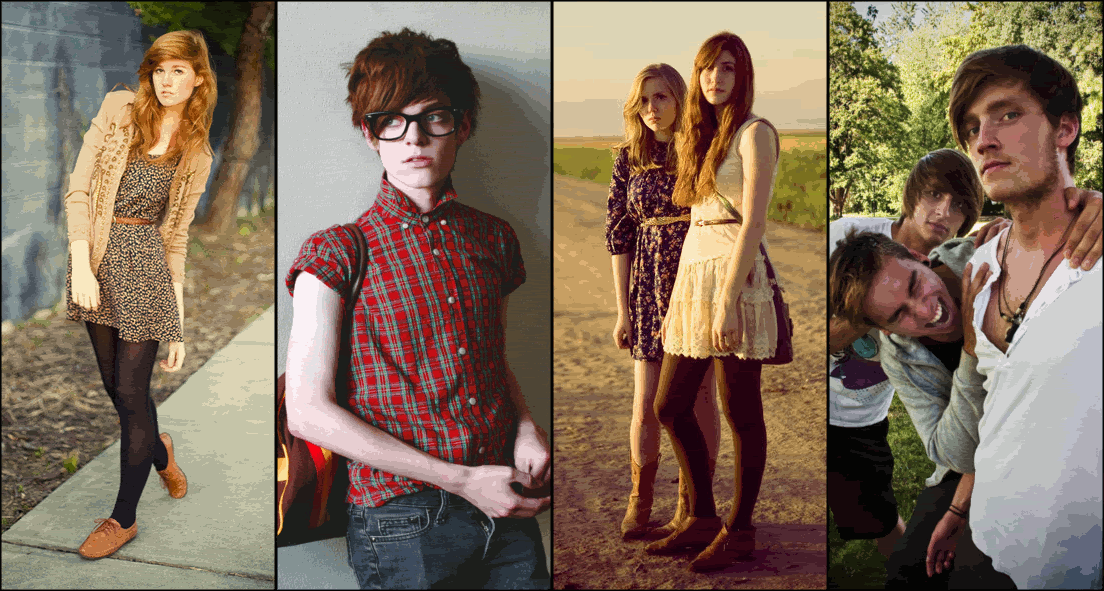
Above are a few images of how I imagine followers of my magazine to look like. I expect them to be young and inspirational individuals, who believe and achieve to live an enjoyable life with traditional values and open-minded attitudes.
My Audiences Taste In Music? Indie/alternative/electronica, artists that are often not too well known within the mainstream and could be considered unique and versatile, rather than generic and commercial - eg. MGMT, Delphic, Florence & The Machine, Mumford & Sons, The XX. Each of these were mentioned on my contents page which should assist in attracting these people.
Their Clothing? Often very casual, or supposedly "cool and trendy" - vintage, preppy, retro, mix & match; shopping at places like Topman/shop and Hollister. Plaid shirts, floral patterns & skinny jeans etc would be worn, and this style of fashion runs through my magazine, shown by the clothing worn in its cover feature, Leanna.
Their Favourite TV Programmes? Music channels such as VIVA and 4Music, teen dramas including Skins and The Inbetweeners, comedies, reality shows or documentaries - as I view my target audience as quite artistic, intelligent and well educated, therefore finding interest in learning about new things or experiences.
Their Main Interests & Hobbies? Attending gigs and festivals, socialising with friends (and parties), shopping, travelling, writing and reading - quite music orientated.
Socio-Economic Groups
It believed it was important to research the different socio-economic groups before producing my magazine, so that I was able to categorise my own target audience. I found the following information on a site called Market Research World:
"Market Research agencies often divide the population into different groupings, based on the occupation of the head of the household, for the purpose of drawing comparisons across a wide range of people - it is used to see how people in differing socio-economic situations react to the same stimuli. The groups are most often defined as follows:-
A- Higher managerial, administrative, professional e.g. Chief executive, senior civil servant, surgeon
B - Intermediate managerial, administrative, professional e.g. bank manager, teacher
C1- Supervisory, clerical, junior managerial e.g. shop floor supervisor, bank clerk, sales personC2 - Skilled manual workers e.g. electrician, carpenter
D- Semi-skilled and unskilled manual workers e.g. assembly line worker, refuse collector, messenger
E - Casual labourers, pensioners, unemployed e.g. pensioners without private pensions and anyone living on basic benefits"
As stated earlier, I view my readers as fairly knowledgeable people, therefore I think they fit best at the higher end of the scale, perhaps between group B and C2. However, in my opinion these groups are far too blunt and broad as they do not specify anything of their music tastes, making it almost totally irrelevant to the subject in hand. Members of the public would buy my magazine depending on their preferred genres of music and general interests, regardless of their occupation or profession, and financial state. I believe my magazine to have a niche audience, because it is only specialised for a small fraction of people with quite a unique interest, and would not appeal to the masses.
Social Groups
Generalisation and stereotypes are now a common occurence in todays society, although they are often grouped to detemine the target audience for a product, in this case for a music magazine. For example, Kerrang! may be aimed at emos and grungers, whereas Q may be for trendies and hipsters. However, I believe this is too vague a way of labelling people - as there are many who would
 not fit into any of the various categories. To the left is a spider diagram I located at UKTribes.com, and its represents the different social groupings currently in Britain. My magazinne has a clear niche audience, and is aimed at people with a liking towards indie music, so I should focus my attention more to the groupings within the Alterntative category. Nevertheless, I still believe this is too vast a classification, and the arrangement is not specific enough, as I doubt goths would find much enthusiasm when reading my magazine - as they have their own specialised tastes in music as well and would most probably disapprove of the leading genre in Dare.

No comments:
Post a Comment